Showing posts with label Reading Diary B. Show all posts

Wednesday, April 27, 2016

Week Fourteen Reading Diary Continued: Twenty Jataka Tales, Noor Inayat


The second half of Twenty Jataka Tales was much more interesting.  I enjoyed reading the stories as I found the moral of the stories to be more direct than the first half. 

The Patient Buffalo
The buffalo experiences annoyance by a small monkey who takes advantage of his patience. A fairy visits him, and tells him of his strength.  The buffalo refuses to act out in anger towards the monkey and is blessed with a charm.

The Goblin Town
Goblins portrayed themselves as women to lure men into their city.  They fed them and chained them with their magical powers.  Only a few were able to break away, with the help of a large horse flying down from the heavens to save them.

The Great Elephant

An elephant came across men who were dying of hunger and thirst in a desert.  He told them of a place where they would be able to find food.  He quickly left and sacrificed himself.  When the men found the place the elephant referred to, they cried knowing that he sacrificed his self for them to live.  

Bibliography: Twenty Jataka Tales retold by Noor Inayat

Wednesday, April 20, 2016

Week Thirteen Reading Diary Continued: More Jataka Tales, Ellen C. Babbitt

While reading the second half of More Jataka Tales, I found it to be more interesting.  The stories were longer, and I was able to get more out of the characters and how they interacted with others. 

The Brave Little Bowman
Looks can be deceiving: A little bowman disguises himself as a page in order to be a part of a king’s army.  The bowman recruited a large man and told him that they both could share the pay that the king would give them; the small bowman will do the work while the large man would be the face. The large man took credit for every act the small bowman did, and was paid for them.  He soon became greedy, and was found out by all.  

The Foolhardy Wolf
 A starving wolf asked a lion for help.  He, the wolf, would be his servant and look for animals for the lion to kill.  As time passed, the wolf began to become larger and stronger from all of the killings and wanted to take the place of the lion.  The lion agreed, but knew the wolf was not tactful, only full of pride.

The Stolen Plow 
A town trader loses his son to a large bird, and a village trader’s plow was eaten by mice.

Prince Wicked and the Grateful Animals

A prince by the name of Wicked was ungrateful towards an old man who saved his life, but he promised to make him wealthy once he became king. When Wicked became king, he denied the old man of the promise and wanted him killed.  The old man told the townsmen of his act of kindness, and he soon became the king of the land. 


Thursday, April 14, 2016

Week Twelve Reading Diary Continued: The Sacred Tales of India, Dwijendra Nath Neogi


The Nil-Sashthi Ceremony
The Fatal Oath

Bijaya learned that her mother had died when she went to visit her family.  She asked her sister-in-law who her mother had entrusted Sashthi with, and they told her that her mother had passed Sashthi down to her.  Bijaya questioned her inheritance, and after doing so, her husband, children, brothers and their children fell to their deaths.

Bijaya left to find the goddess and called upon her for answers. Bijaya with humility, asked Sashthi to bring her family back.  Sashthi told her the pujah that she must perform.  Bijaya performed the pujah and her family came to life.

The Manthan Sashthi Ceremony
The Sacrificed to Varuna

Varuna came to a Brahman in a dream and told him, in order to be blessed with water his grandson must be cut into five pieces with his body part spread over the land.  The Brahman’s son learned if the secret and sacrificed his son for Varuna.  Water appeared and a feast was planned. 

The mother went looking for her child and called upon Sashthi. She performed a pujah ceremony and an old woman appeared.  She gave her infant child to her, and rejoiced while returning home to see her husband and father-in-law in shock.

The Joymangalbar Ceremony
Joyabati-The Gift of Joya

Joya in disguise as a hungry Brahman refused the food of a man by the name of Kanak Sen who was daughterless.  The man asked the “Brahman” to bless him with a daughter.  Joya gave the man a drug for him and his wife to consume. Joya then told the man to name his daughter Joyabati when she is of marriage age, and marry her off to a boy by the name of Joydev.  Joydev has six sisters, and he is the only male in his family.

When the two had married, Joydev questioned Joyabati’s devotion to Chandi.  He believed that no such goddess could do the great things that his wife mentioned.  He threw her jewelry into the ocean, severed their child’s head off of his body, threw their child in fire, and drowned him.  In each occasion their son was saved, and Joyabati’s jewels were recovered.

The Aranya Sashthi Ceremony
Saved from the Cat

A grandmother who was a Brahman experienced her grandchildren being taken away by the cat of the goddess Sashthi.  Sashthi told the Brahman that her grandchildren were taken away because her daughter in-law had anointed herself with oil on the day of her pujah. She will be given another son, but she must not allow him to anoint himself with oil.  The grandmothers did so, and helped those who she had encountered on her way meeting Sashthi.

The Pashan Chaturdasi Ceremony
The Wife Who Used to Eat the First Morsel

A Brahmani woman questioned why her grandchildren had all dies in the cradle where they slept.  A wise man told her, it was because she always ate the first morsels, and that she has never given the opportunity to her daughter in-law.  The woman sent her daughter in-law away and cleaned their home, and cooked as well.  She came home happy and saw that the day of the Chaturdasi Ceremony she would be the first to eat.  When she did so, she was blessed with birthing the children that she had lost.

The Guha-Sasthi Ceremony
The Wife Who Cooked Beef

A Brahman wanted his daughter in-law to prepare a feast of tortoise and curry.  She ate all of the food after what should have been a taste.  The servant of the daughter in-law went outside to a nearby field a killed a calf.  The calf would not cook right and she believed it to be a forbidden meat.   When it came time to serve the meat the daughter in-law fell and the servant touched the pot, making the food not edible because she was of lower caste touching the food.  The daughter in-law performed a pujah and the calf was brought back to life, and the women were forgiven.

The Cawra Cawra Ceremony
The Banished Girls


Amuna and Jamuna were banished from their home by their stepmother.  Lakshmi found them in the forest and disguised herself as an old woman.  She wedded the sisters.  One sister wedded a prince, and the other a minister.  Jamuna continued to praise Lakshmi for all that she had done and was blessed for it.  On the other hand, Amuna stopped worshiping Lakshmi and suffered greatly.  After much misfortune she began to worship Lakshmi again.  

Wednesday, April 6, 2016

Week Eleven Reading Diary Continued: Sacred Tales of India, Dwijendra Nath Neogi

The Budhastami Ceremony
The Bride of Yama, the King of the Dead

Kausik and Bijaya search for their missing bull that was stolen from them.  When they find their bull, they see celestial beings dancing around the bull.  They were told by on e of the beings to go home and do the Budhastami ceremony, and once they finish the bull will be returned to them. Once they finish the ritual, Paravati grants them two boons.  Kausik will become king and Bijaya will marry Lord Yama. 

When Bijaya marries Yama, he tells he where she may and may not travel around their home.  Curiously, she travels to the south grounds on their property and sees her mother burning “in hell”.  She asks Yama to release her but he cannot. He tells her to visit her brother first and see if he would be willing to give up a portion of his riches.  Kausik declines to help his mother because he does not want to become poor.  She then visits a poor Brahman woman who is willing to sacrifice a portion of her reward that she was given when she practiced the Budhastami Ceremony.

The Mangal-Chandi Ceremony
The Goddess who Devoured Elephants

Lahana and Khullana were married to a man by the name of Ratnakar.  Lahana was jealous of Khullana.  Because of her jealousy, Ratnakar banished her form their home.  When Lahana walked through the forest she met people who were worshipping.  They told her of the goddess Mangal –Chandi, and the blessings that she gives.  After hearing a story about a hunter and his wife, Lahana began her pujah.  She wished for her husband to take her back, and he appeared. 

She was blessed with a child, Sadanand.  When Sadanand grew older, Ratnakar was not present.  He travelled to Sinhal and never returned.  Sadanand wanted to look for his father.  He and his mother called upon Mangal-Chandi for her guidance, and the Sadanand left for Sinhal.

Like his father, Sadanand saw Mangal-Chandi sitting on a floating lotus forest eating elephants.  He told the king, and the king ordered Sadanand to be executed.  Mangal-Chandi appeared, and told the king to release Sadanand and his father from the jail.  Mangal-Chandi ordered the king to give Sadanand a wife and half his kingdom.  After all was done, they set sail back home where they met Khullana.

The Janmashtami Ceremony
The Slayer Kangsa

The gods had came together to petition Kangsa for his behavior.  He was being a tyrant, and had killed all of the children of Devaki.  Vishnu had order the gods no to act upon killing him, but let him do it.  Vishnu would be born to Devaki in human form, and when he is older, he will commit the act.  Kangsa tried to kill Vishnu when he was born, but he was switched with Yasoda’s daughter.

Vishnu grew up as Yasoda’s son.  When it was time for him to complete his task, he broke Kangsa’s great bow and killed Kangsa.  Kangsa was sent to heaven although he committed grave acts on earth. 

The Padma Pujah Ceremony
Chand, the Unbeliever

Padma was born to Mahadeo, a god.  When he took her to heaven, her stepmother Bhagavati saw her as competition and was filled with jealousy.  Bhagavati ripped one of her eyes out and had Mahadeo banish her from the heavens and have her sentenced to live on earth. On earth Padma found a man by the name of Chand.  Chand was rich and had an ill-stricken wife and six sons.  Padma wanted Chand to take her as his wife but he refused.  He believed that she was an imposter. 

Padma had Chand’s children killed, and ordered him to worship her.  Many times, he refused until Lakhindars was brought back to life.  


Wednesday, March 30, 2016

Week Ten Reading Diary Continued: The Mahabharata, Peter Brook

Part D - The Art of War


After nine days of battle, men end the day with their rituals. Bhishma who is injured, meets with the Kaurava brothers, Karna, and Drona in his quarters. Duryodhana tells Bhishma that he is disappointed with his performance and how it is his fault that they have not succeeded in the war.  

As the Kaurava brothers and Karna leave Bhishma’s quarters, Drona stays behind.  Bhishma tells Drona of his dream.  In his dream, a stranger kills him.  Drona laughs as Bhishma tells him, and Bhishma asks why someone would kill him.  Drona responds that only you  know the answer. 

Bhishma is left to think about how he will win the war against the Pandava’s.  He hears a sound outside of his quarters and knows that it is Amba, the princess that he turned away earlier in the epic.  Amba walks into Bhishma’s quarters and tells him that she has been following him all of these years and that her feelings of revenge have not changed.  Amba then reveals that she has a secret, she will partake in the next battle and that she has taken on a man’s image.  Her new name is Shikhandi.

This scene is not how I depicted it in my mind.  Brook was able to make the scene dramatic especially with the music that played as Amba spoke to Bhishma.  I did not gather that Bhishma was frightened from Amba’s presence, nor was he uncomfortable.  In the movie it seemed as if he knew his life was going to end.

When Kunti approaches Karna and they have the conversation about his birth, Karna cannot help but acknowledge that after all of these years Kunti has abandoned him.  The only possible reason why she would want him to side with the Pandava's is because of the power that she possesses and the thought of her losing a son.  


Bibliography: “The Mahabharata” directed by Peter Brook (1989)
                     “The Mahabharata” written by R.K. Narayan (1978)

Thursday, March 24, 2016

Week Nine Reading Diary Continued: The Mahabharata, Peter Brook


Part B of Peter Brook’s The Mahabharata was intriguing and comical.  The dice game that was portrayed in the written version of The Mahabharata was as intense as the movie; yet there were differences that can be pointed out. 

Yudhishthria displayed the same desperate behavior in the movie as he did in the written prose with one exception.  He acknowledged that he was a terrible gambler.  Yudhishthria continued with his plans of participating in the dice game and showed his weaknesses of not being able to possess self control.  What I found interesting is that the king’s wife Dhritarashtra, was very vocal during this particular scene.  She interrupted the game by asking Yudhishthria if he wanted to end the game before he bet the freedom of his brothers and wife.  Yudhishthria being a person who does not possess any self control wished to continue the game and lost.


When it came time to bring Draupadi to the court after the game of dice ended, Dhritarashtra again was not quiet when it came to sharing her opinion on the situation.  In both versions, Draupadi questioned the right of husband to gamble his freedom if he had already lost his.

Draupadi's thoughts: A man cannot sell something when he does not posses the right or freedom to do so, and if Yudhishthra was already a slave then what possessions could he give?

Unlike the film, in the written prose the men of the court argued against Draupadi and in so many words wanted her to stay in a woman’s place. It was a child who spoke up for Draupadi’s freedom and logically explained the circumstances of the matter.

In the film, Dhritarashtra made the decision as to Draupadi being sold as a slave, and believed that it did not make a difference whether her husband was a free man or a slave at the time when he gambled her freedom away.

Throughout this part of the movie, Dhritarashtra played both sides of the fence when it came to her children and husband.  She is a manipulative character.

Bibliography: "The Mahabharata" directed by Peter Brook (1989)
                       "The Mahabharata" written by R.K. Narayan (1978)

Wednesday, March 2, 2016

Week Seven Reading Diary Continued: The Mahabharata, Epified

The second part of The Mahabharata narrated by Epified was interesting like the first.  I really loved the emotion that the narrators portrayed of the characters and the artist did an excellent job by showing great details in regards to the characters movements, the characters personable traits like the reactions on their faces in regards to the matters they were dealing with, and lastly the back ground scenes where things took place.

 I especially enjoyed the story of Karna and the details in which the narrator explained the characters and their actions.  Karna was a very admirable character in the story; he appreciated his parents for everything they had done for him.  Because he knew he was sewn from a different cloth, after his encounter with Drona not once did he mention that he was born from a higher class and was “adopted” by people who were of a lower class.  He had the opportunity of explaining how he received his great warrior instincts, but he felt that if he were to explain the truth it would be a way of betraying his real parents, the ones who saved his life from the basket that was floating in the river.  His parents felt bad because they knew that Karna wanted to train, but with patience and time, a great sage had helped him.


The character of Drona was different than what I expected.  I portrayed him as an older man who was wise and very caring.  In Epified’s version Drona was a bit cold and harsh.  They made the character seem as if status and money was the only way to spark interest in training other young men besides the Pandava’s.  

Bibliography: "The Mahabharata" written by R.K. Narayan (1978)
                     "The Mahabharata"  narrated by Epified (2015)

Wednesday, February 24, 2016

Week Six Reading Diary Continued: " The Mahabharata" R.K. Narayan

In the last part of “The Mahabharata”, Yudhistira and his brothers are joined by their faithful friends and followers.  The Panava’s would like to continue their lives the way it was before they were exiled by their cousin Duryodhana.  Duryodhana wants to continue to isolate his cousins and start a war with them.  He continues his attitude of wickedness and shows his insolent ways by refusing to acknowledge that they have successfully completed their twelve years and was able to live incognito without being noticed.  His father King Dhritarashtra, as always, wants to play a fickle role between his nephews and his sons.

Yudhistira thinks of a solution that would be favorable to both the Panava’s and the Kaurava’s.  He asks for his half of the kingdom back, and if not half at least be given five villages.  Each village will represent the land that his he and his four brothers will rule.  They will continue to lives their harmony and without interfering in the lives of the Kaurava’s. Krishna leaves to Hastinpura on the behalf of Yudhistira to negotiate.


King Duryodhana is not sure how he can please Duryodhana without him being upset.  He lets Duryodhana continue his plot against his cousins without interfering.  Seeking help from his faithful friend and adviser Vidura, Dhritarashtra understands that his nephews should be treated fairly but he feels perplexed about the issue.  Duryodhana finds many to back him in the war that he will commence against his cousins.  His jealous brothers too want in on the action and are ready to become the only heirs to the throne. 


All ends tragically because one human being was not stopped and corrected of his selfish ways.  


Bibliography: "The Mahabharata" written by R.K. Narayan (1978) 

Thursday, February 18, 2016

Week Five Reading Diary Continued: The Mahabharata, R.K. Narayan

In part B of the reading "The Mahabharata", I noticed the jealousy that has risen in Duryodhana, eldest son of King Dhritarashtra.  When invited to Indraprastha, the kingdom where his cousins rule, Dhritarashtra complains to his uncle Sakuni about his visit on his way home.  He admits that his cousins are well off and that they have made a beautiful kingdom out of a desert.  The kingdom is now looked at as the most fascinating and advance kingdom in comparison to Hastinapura.  His cousins, have found favor in the eyes of their residents, and are treated with much respect.  They honor the residents of the kingdom more so than those who live in Hastinapura by giving them gifts and treating them with high admiration.


Dhritarashtra feels that his cousins went out of their way to make him feel uncomfortable throughout his visit in the City of Splendor.  He recalls them laughing at him every chance they received.  When he arrived at their great hall of marble, he was unable to distinguish what was what.  He was often confused as to whether he was walking on high polished marble floors, or in water.  He mentions the painting on the wall looking realistic to the point where he tries to grab the rose from the painting. When Dhritarashtra arrives home, he immediately tells his father King Duryodhana about the trip.   Sakuni talks to Duryodhana, and Duryodhana ignores Sakuni’s comments about his son’s jealousy.  In order to please his son, Duryidhana builds a great hall of his own in order to over shadow his nephews.

When Duryodhana’s great hall is completed, he invites his nephews to visit.  It is then when I believe that Dhritarashtra came up with the plan of enticing his cousin Yudhistira to a game of dice, resulting Yudhistira to bringing himself and his family in debt and a life of solitude.  Yudhistira, his brothers, and their wife are sentenced to live in exile for a period of thirteen years, and during this time Dhritarashtra concocts a plan to attacking his cousins so he and his brothers can take over their cousin’s land that their father granted them.


Bibliography: "The Mahabharata" written by R.K. Narayan (1978)

Thursday, February 11, 2016

Week Four Reading Diary Continued: Sita Sings the Blues, Nina Paley

In the second half of Sita Sings the Blues, the characters Nina and Dave start to evolve more.  We see them in the first half as this loving couple that lives in San Francisco who are shown throughout the movie in glimpses.  Dave starts to distance himself from Nina after moving to India for his job.  When Dave is on a long distance call with Nina, he tells her that his job has decided to extend his contract, and Nina wonders where she stands in Dave’s life.  After visiting Dave in India, Nina sees a different side of him. He is no longer affectionate towards her, and he treats her as if she’s a random woman he met off the street.


Their relationship in the movie is symbolic.  It is referenced towards Rama and Sita’s marriage.  After Rama defeats Ravana, Rama feels that Sita’s purity is unknown.  She has lived with Ravana for months, and he doubts her faithfulness since she has lived in another man’s presence.  When Sita proves to Rama that she had not betrayed Rama, he takes her back to Ayodhya where Sita then claims that she is pregnant.  The people began to speak down on Rama and he believes that he cannot properly rule as a king if his people cannot respect his decisions regarding Sita, so he banishes her. 


The three narrators of the story (the shadow puppets) began to debate about this.  On one hand Sita is showing her devotion to Rama.  She continues to pray and channel her energy and good thoughts towards him, while she is in exile.  It is argued that Sita is displaying unconditional love, and because of this she’s considered to be dumbfounded.  Moreover, we see Nina who receives an email from Dave, ending their relationship.  Nina later calls Dave and asks for him to take her back.

At the end of the movie, Rama resurfaces back into Sita’s life only in hopes of taking his sons back to the city with him.  Once again Sita must prove her faithfulness to Rama and because of this; she calls on Mother Earth and lives her last days in the heavens; whereas Nina finds comfort in being alone after taking control of her life and happiness.


These women displayed throughout their relationships their admiration and content with their partners, and in the end are left alone because of either insecurity or lack of interest.  They took a hold of their destiny to find themselves happy alone without the pressure of finding approval through their men’s eyes.    


 Bibliography: "Sita Sings the Blues" Nina Paley (2008)
                        "The Ramayana" written by R.K. Narayan (1977) 

Thursday, February 4, 2016

Week Three Reading Diary Continued: The Ramayana, R.K. Narayan

The story comes to an end in the epic novel "The Ramayana" I see this story in a completely different light.  It is not what I expected, but I enjoyed reading it from the very beginning to the very end.  I saw Rama go through immense trials trying to defeat Ravana, and those on Ravana's side.  With the constant reminder of Sita on his mind he shows that while in battle, his everlasting love for Sita remains unchanged.

Rama and Sugreeva finally meet after Lakshamana travels to Kishkinda and confronts Sugreeva on the behalf of his brother.  Feeling guilty, Sugreeva acknowledges his negligence towards Rama and apologizes for his foolish behavior.  He soon tells Lakshamana that it is not that he “completely forgot” about Rama, nor the severity of the situation, but his allies have not given him word as to whether or not they will be able to help.

After offering Lakshamana a bath and a place to lay his head, Lakshamana reminds Sugreeva that his brother Rama is still in the forest waiting.  Rama is unable to experience such luxury, and he too will not experience it either.  What must take place is a meeting between him and Rama explaining the circumstances of the situation.

Sugreeva (and I too), admire Lakshamana’s loyalty to his brother and agrees to go to the forest where Rama is residing. After Sugreeva apologizes for his actions, and mentions that the rainy season had lasted longer than what was expected.  He would not give up on his mission, nor betray his trust.  Soon, the soldiers of Kishkanda are sent out to look for Sita.  Much time passes by, but then Hanuman and the soldiers receive information as to where Sita is being held in captivity.  When Hanuman travels to Lanka in hopes of finding Sita, he lands a visit with Ravana.

This part of the story stood out the most to me because of the actions Hanuman had taken after his meeting with Ravana.  His tail was lit on fire, and while leaving Ravana’s haven, Hanuman set everything on fire while he was leaving the city.  The description of the cities appearance and smell is to familiar to me, and surely I thought that Ravana would have disregarded his advisement to not kill Hanuman because he was a messenger.  


Bibliography: "The Ramayana" written by R.K. Narayan

Tuesday, January 26, 2016

Week Two Reading Diary Continued: The Ramayana, R.K. Narayan

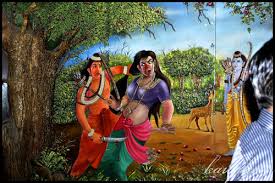
The jealousy of Soorpanaka takes over her beautiful human appearance as she shows her true demonic behavior when she insults the sights of Sita as Sita walks out of the cottage and clings on to Rama.  Enrage at seeing this, Soorpanaka asks Rama to dismiss Sita and recognize her for the fake that she is.  When Rama sees that her disguise as a beautiful gentle being is not true, he rejects Soorpanaka.  Soorpanaka leaves unwillingly and she hides in her cave, where she dreams the dreams that Sita once dreamt as Rama consumes her mind. Because of her persistence and her want to eliminate Sita from Rama’s life, Soorpanka’s actions lead her to being disfigured by Lakshmana.  Lakshamna cuts Soorpanakas’ nose, ears, and breasts off after catching her trying to do harm to Sita. Soorpanaka then resorts to going to her brother Ravana after many attempts of trying to kill Sita and Lakshmana, and capturing Rama to be her husband.  She describes Sita’s beauty to her brother, and he then becomes infatuated with the thoughts of her.


The true tale of Ravana unfolds unlike what is told in the movie “A Little Princess”.  Ravana sets up a diversion with his uncle Mareecha who knows the true power of Rama after his previous encounters with the god-like mortal.  Mareecha disguises himself as a deer of gold with emeralds on his feet, catching the desire of want from Sita.  After much thought Rama leaves to catch the beast and leaves his wife under the protection of his brother Lakshmana.  As time passes, and Rama finds out he has been tricked, Rama kills Mareecha; however, before his death Mareecha cries out in the voice of Rama “help me!”


Sita hears the voice and believes it to be her love.  She convinces Lakshmana to look for his brother, or she herself will die.  Lakshmana reluctantly leaves in search for his brother, and Ravana appears from the bushes where he was hiding as an old man in disguise.  Winning Sita’s trust, he comes into her cottage and as their conversation goes on, he feels disrespected and hurt that Sita puts her husband above him.  He turns into the beast that he is, and kidnaps Sita and takes her to Lanka as his prisoner.  


Bibliography: "The Ramayana" written by R.K. Narayan