Sunday, January 31, 2016

Topics: Week Two

For the project, I decided that I want to do a storybook.  I enjoy our storytelling assignments, and this project will let me be creative in choosing how I want the characters to be, and what kind of lives they should live.  The four topics I am most interested in is


Karma

Karma has always been an interesting topic to me, and I do believe what one does in order to get over, comes back ten-fold. A person's karma can always change, it depends on the choices that they make within their everyday life. I believe that the good one does, out weighs the bad and it shows in the end.  However, when considering Hinduism and reincarnation, I think life choices are made carefully when considering  being inflicted by pain in the next next life if one continuously inflicts pain on others. In addition to the thoughts of being reincarnated into an insect after killing an insect in ones previous life. 

Research so far: I looked at some storybooks that were previously done and they were great, but I was looking for something grim. However I found a website, Heart of Hinduism: The Law of Karma that explains the Law of Karma, and how to avoid bad Karma especially with the beliefs of reincarnation.


Love Stories

Love stories will always be told, and I recently did my storytelling assignment over Sita and Rama, which turned out to be more of a relationship full of secrets.  I might expand more on the assignment, or give them a fresh beginning and ending with more twists and turns.  Rama and Sita are the ideal couple in Hindi epic tales, and I would probably still give them the great reputation they have, but show behind doors that their life is not what it seems.

Research so far: Aside from Ramayana, I looked at different versions of the story on the internet, mainly written by people from India, or lived in India. 


Geography Stories: Traveling India

I think this topic is one that I am geared towards the most.  India is a beautiful place from the pictures I have seen, and I will be able to imagine the sites through the characters eyes, giving them the traveling experience that I want. I also find the culture and traditional garments to be beautiful, so with the pictures I find, I would be able to express the story in the light I want it to be seen in.

Research so far: I have looked up maps of India and Ancient India.  I also looked up information about the country’s history, and government.  


Death Stories

This topic would allow me to be grim and use the tales of demons and goddesses and pit them against each other more so by making up a past history that involves both sides. When skimming through some of the stories of the demons, I noticed all the stories I looked at, the demons were all killed by goddesses, which was something that peaked my interest.


Research done so far: I looked up how many Hindu demons, there are twenty-two, and I read some of their stories.  By far I’m most intrigued by Arunasura and Durgamasur. 

Thursday, January 28, 2016

Week Two Storytelling: Sita's Secret

As they both stared out the double-paned windows that covered each wall of the office, Dr. Kevorkian wondered if Sita would answer his questions.  Each time they would meet, she looked for the chaise lounge that was adjacent to his desk.  It was there where she lay down with her legs crossed and arms dangling from both sides, twisting the strands of the white shag carpet.  Dr. Kevorkian had never encountered a patient like her, but then again after twenty years, he had only had three clients. He found his calling in the field of psychology and being a part-time life coach to those who were in need of motivation and confidence-building.  When he started his practice, the courts assigned Sita to Dr. Kevorkian after her abduction.

Dr. Kevorkian: Sita, are you going answer my question?

Sita: And what question was that?

Dr. Kevorkian: How did you feel when Ravana abducted you?  From the court's transcript, you never answered the question.  You said, and I quote...

“When Ravana took me from my love, I only imagined that I would be lost from his arms forever.  Each day I spent at Ravana’s palace became another night, and another night became another week, which turned into months at a time. I would kneel in the room of jewels and gems near the fireplace that burned an everlasting fire, while Ravana would stand behind me breathing what felt like a warm mist on my neck and whispering things in my ears. He then would put his hands on my waist, two on my shoulders, and one in my hair.”

So, what I asked you, and have been asking you for the past twenty plus years is, how did you feel? What emotions came over you? Did you think that Rama would save you?

Sita: Maybe you’re asking the wrong question.  Maybe you should ask if I went willingly.

Dr. Kevorkian: Did you?

Sita: Rama stated in court that day, “Sita had an opportunity to jump from Ravana’s shoulders, but then again she is afraid of heights.” Did you not tell Rama that I blame myself for the abduction, and the reason why I continue to have nightmares is because of a guilty conscience?

*Sita sits up looking at Dr. Kevorkian after not receiving an answer.*

Sita:  What are you writing?

Dr. Kevorkian: My grocery list. Would you like to see?

Sita: No…but I want to tell you something.

Dr. Kevorkian: Okay?

Sita: Sit next to me.

Dr. Kevorkian: You can’t tell me while I sit here, and you sit there?

*Sita pats the chaise lounge signaling Dr. Kevorkian to sit next to her.  He stands up and walks near the chaise lounge with his yellow legal pad in hand, and proceeds to sit down.*
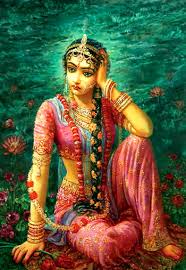

Sita: When I was four, my mother had a best friend who built her home next to our palace.  I could see her home from my window.  It was covered in ivy vines and golden-colored bricks.  Each day, my mother and her friend would go into the garden, and my mother's friend would bring her son Aakarshan.  He had a gift of attracting butterflies, and he would call upon them so they would sit on the flowers and fly around in the garden.  Sometimes, Aakarshan would whisper to one whenever he knew I was watching him from behind a tree, and tell it to fly near me and land on my shoulder.  We became close over the next few years until my mother died.  From then on, her friend and son was banished from the palace because Papa was overwhelmed by the memories of mother. I always looked out the window to see if I could catch a glimpse of them from their patio, and I never did.  As the months passed, those windows were boarded up, and the house was left empty.  When Papa finally gave me freedom to walk to the market with Pahdam, my governess, it was there in the market where I saw the beautiful butterfly boy.  I ran up behind him and put my hands over his eyes.

“Guess who?” I said.

The man started to smile and turn around. He looked me in my eyes and said,


“Girls like you should be more careful when touching men they do not know.  It may come off as promiscuity unless that is what you are aiming for.”

I was confused, and I did not know why he was being cold.  I knew those chestnut brown eyes, coal black hair, and skin that was the color of amber.  He even smelled of honey and lavender.  I just stood before him, and he yelled at me to go.  Each night I thought of him until the day I met Rama.  When Ravana abducted me, I began to think of Aakarshan. Our mothers would tell us the stories of the Gods and demons that walked amongst us here on earth, and the story of Ravana was my favorite.  Aakarshan and I would run around the garden and pretend that Ravana had taken me far far away, and each time Aakarshan would save me.  When Ravana did abduct me, I wanted Aakarshan to save me. I hoped for him, and I prayed for him. Rama ended up defeating Ravana, not Aakarshan.  When I dream, I don’t dream of Ravana.  I dream of Aakarshan and of him holding me in his arms.  When I wake up, I see an unrecognizable man lying next to me.  Can I tell you a secret?

Dr. Kevorkian: Yes.

Sita: Before I married Rama, I found out that Aakarshan was actually the first man to complete Father’s task with the bow of Dhanush Shiva, not Rama.  Phadam told me that Aakarshan proved to papa that he was worthy to take my hand, and Papa told him no.  So when I was abducted by Ravana, truth be told… I did go willingly.
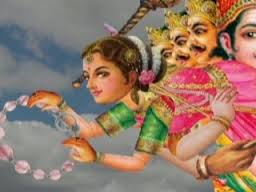

Author’s Note: This story was inspired by the Indian Epic “The Ramayana” written by R.K. Narayan.  In the epic, a princess by the name of Sita fell in love with a Prince named Rama after only seeing him once.  Rama too fancied Sita.  Rama did not know that Sita was the daughter of King Janaka. Sage Vishvamitra ordered Rama to complete King Janaka's bridal task. Any man who was able to complete the task would marry King Janaka's daughter.  King Janaka's bridal task consisted of a man stringing the bow of Dhanush Shiva. In Rama’s attempt, he broke the bow into two pieces showing the great power that he possessed.  Rama and Sita wedded after receiving the blessing from Sita’s father.  When  the wedded couple arrived to Rama's palace, Rama's father felt that he should be the chosen one to rule over their land.  When Rama's stepmother discovered this, she protested and reminded the king that he promised the throne to her son. Rama was later sentenced to exile in the forest for a period of fourteen years.  Sita followed her husband into exile, and was abducted by the demon king Ravana.  Ravana took Sita to Lanka where he resided and later was defeated by Rama in battle.


      For this story, I wanted to give Sita a life before Rama.  In the epic, readers are not given any information on her life previous to her meeting Rama.  I felt that Sita was not her own person, but lived in Rama's shadow. Adding the character Askarshan to the story was eliminating the attention that was given to Rama.  I wanted Sita to experience a love before Rama, a love that she had never quite gotten over.  Moreover, I chose Dr. Kevorkian to be her psychologist because was an advocate for assisted suicide.  He believed that a person should be able to make their own decisions when it came to their personal lives whether it was considered moral or immoral by law. 


Bibliography: “The Ramayana” written by R.K. Narayan (1972)

Tuesday, January 26, 2016

Week Two Reading Diary Continued: The Ramayana, R.K. Narayan

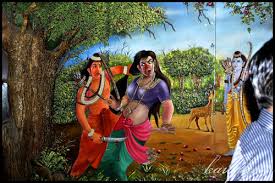
The jealousy of Soorpanaka takes over her beautiful human appearance as she shows her true demonic behavior when she insults the sights of Sita as Sita walks out of the cottage and clings on to Rama.  Enrage at seeing this, Soorpanaka asks Rama to dismiss Sita and recognize her for the fake that she is.  When Rama sees that her disguise as a beautiful gentle being is not true, he rejects Soorpanaka.  Soorpanaka leaves unwillingly and she hides in her cave, where she dreams the dreams that Sita once dreamt as Rama consumes her mind. Because of her persistence and her want to eliminate Sita from Rama’s life, Soorpanka’s actions lead her to being disfigured by Lakshmana.  Lakshamna cuts Soorpanakas’ nose, ears, and breasts off after catching her trying to do harm to Sita. Soorpanaka then resorts to going to her brother Ravana after many attempts of trying to kill Sita and Lakshmana, and capturing Rama to be her husband.  She describes Sita’s beauty to her brother, and he then becomes infatuated with the thoughts of her.


The true tale of Ravana unfolds unlike what is told in the movie “A Little Princess”.  Ravana sets up a diversion with his uncle Mareecha who knows the true power of Rama after his previous encounters with the god-like mortal.  Mareecha disguises himself as a deer of gold with emeralds on his feet, catching the desire of want from Sita.  After much thought Rama leaves to catch the beast and leaves his wife under the protection of his brother Lakshmana.  As time passes, and Rama finds out he has been tricked, Rama kills Mareecha; however, before his death Mareecha cries out in the voice of Rama “help me!”


Sita hears the voice and believes it to be her love.  She convinces Lakshmana to look for his brother, or she herself will die.  Lakshmana reluctantly leaves in search for his brother, and Ravana appears from the bushes where he was hiding as an old man in disguise.  Winning Sita’s trust, he comes into her cottage and as their conversation goes on, he feels disrespected and hurt that Sita puts her husband above him.  He turns into the beast that he is, and kidnaps Sita and takes her to Lanka as his prisoner.  


Bibliography: "The Ramayana" written by R.K. Narayan

Week Two Reading Diary: The Ramayana, R.K. Narayan

Because of my infatuation with the movie "A Little Princess” and I do admit I own a copy of the movie on DVD, I am able mesh the traits of the characters from “The Ramayana” with the characters that played in the movie.  Knowing the background story makes reading the Indian epic worthwhile and far more pleasing than what I have ever imagined.  

Dasaratha, who is the father of Rama, is the king of his land and a man of his word.  After not being blessed with children, he soon pleads and is blessed with four boys; Rama, Bharata, Lakshmana, and Satrughna.  He holds Rama closest to his heart, as a loving father should; however, you see that he favors him more in comparison to his other sons due to Rama's loyalty, kindness, compassion, and honesty.  Rama is a humble young man and obedient to all authority.  He does not make differences out of people and believes everyone should be treated with respect. This trait is often shown when he approaches the people of his country, and his stepmothers who he calls mother, as if they too have given birth to him like his own mother Kausalya.


Swooned out of giving Rama the throne by Bharatas' mother Kaikeyi, Dasaratha does not die because he is old.  He dies of a broken heart because of his son's obedience towards him and his stepmother Kaikeyi. 


Rama and Sita's love surpasses the feelings of infatuation.  They are what I consider the lovers of love.  Helpless romantics who fall in love from first sight, and are in constant thought of the person they have laid eyes on.  They have you wonder if the one you truly love thinks of you as much as you think of them.  Their bond of love has lasted through their reincarnations, and their relationship is built on strength and support, which is an example to all who have not experienced such.


Bibliography: "The Ramayana" written by R.K. Narayan

Saturday, January 23, 2016

Tech Tip: You Tube in Blogger

Hi everyone,

 I hope all is well with you. I’m going to tell you how to embed a You Tube video into your blog.


·         When you sign into your blog, create a new post. 
·         After you write your post, click on the area where you want to embed the video. Like embedding a picture; make sure that you have room when embedding the video in between two paragraphs or at the beginning of your post.
·          Next to link and the photo icon that we use, you will see the clapperboard/time slate.
·          Click on the icon and choose from the options that are given, and then click upload. 


I hope this helps. Have a great day, and message me if you have any questions. 

Learning Challenges


I think all the things that H.E.AR.T. encompasses will bring balance to an individual’s life.  Last year for one of the courses I was taking, the students were required to make up both a weekly and monthly schedule for our professor to determine if we were spending our time wisely. Everyone has different classes, extracurricular activities and responsibilities, and it was interesting to see how everyone uses their time.


Each day I have a set of tasks/objectives that I have to accomplish in order to feel at ease, but overall my life is not balanced.  There are things that I want to do , but I feel like I don't have the time.  I want to take time out of a day to just breath, and get back into volunteering at the City Rescue Mission and with Habitat for Humanity. The time I spend with family and friends has dwindled, and school and work have become all consuming.  With H.E.A.R.T.,  I can learn to focus my energy in areas where it is most needed, and not in areas that I believe are to be more important at that given time.

Friday, January 22, 2016

Growth Mindset

I am glad that I was able to encounter the Growth Mindset research by Carol Dewck.  Although I have never heard of her, I find the “not yet” approach something that should be used not only with children in elementary and junior high, but also with young adults in high school.  After watching the videos, I started questioning myself as a whole, and how I act towards things that are not necessarily comfortable to me academically. I used to be that student who had to have A’s, and it was not until recently before I changed my major from engineering that I understood that it was okay to receive grades lower than an A. Receiving a B/C grade when you put in hard work, time, and effort gives you the motivation to try harder in comparison to receiving an easy A in my opinion.

 I went to multiple schools throughout my life, and I felt challenged as to why I was not learning the given information like some of the students.  I believed the main reason why some subjects were harder than others was because of the different teaching styles that were being used.  In comparison to the schools I attended in Texas and Oklahoma, the schools on the east coast particularly in the DMV (Washington D.C., Maryland, and Virginia) area, teachers were more attentive to their students and their learning capabilities, but their approach was different.  Students were split into different categories or levels of learning.  There were three different math, science, and English classes, and the teachers gave students work that was only beneficial for their learning level unless they were in the advance classes. As a kid, you think “okay, this is cool”, but now after watching the videos I wonder if it has hinder those who were not in the advance courses.


The videos over Growth Mindset has me thinking what can I do to change about my behavior both academically and personally, and how can I become more open and comfortable when I encounter something challenging.  I think this would be useful especially with my Hebrew courses.  This semester I am taking nine hours of the language, and I feel like I can make progress with the Growth Mindset approach.  
"Success is not easy and is certainly not for the lazy." - Samantha Saifer-Berngard